
While the brand's lower ranges also sport network streamers, such as the 6000N Play and 7000N Play, they both utilise the Play-Fi platform. According to the company, the 9000N's additional development budget and higher retail price have enabled Audiolab to explore new high-end solutions for its flagship streamer.

Audiolab says it "selected a platform that is firmly established at the forefront of top-tier network streaming, globally acclaimed for its slick, well-featured app, unwaveringly stable operation, excellent technical specification and outstanding sound quality". With the integration of leading-edge streaming hardware and software, combined with Audiolab's award-winning digital/analogue circuit designs, the 9000N promises to deliver the ideal streaming solution for the most discerning of music lovers.
Built from the ground up, the 9000N uses a powerful, highly efficient quad-core Arm Cortex-A53ARM processor and a Linux-based operating system. The 9000N's main control app provides quick, easy access to fully integrated services such as Tidal, Qobuz, Spotify and TuneIn Radio, with a superbly intuitive yet feature-rich interface that makes browsing a pleasure. Intelligent search functions and the ability to create multi-source playlists, group albums and organise folders create a personalised experience that allows users to discover, sort and play their music however they prefer.

Any UPnP/DLNA app can be used, mconnect or BubbleUPnP, for example, and the provision of AirPlay 2 is handy for users of Apple devices. Naturally, the 9000N is also Roon Ready and can slot straight into a Roon audio environment and work seamlessly with Roon streaming software.
Hi-res audio support is state-of-the-art, handling PCM up to 32-bit/768kHz and native DSD up to 22.5MHz (DSD512) no matter how one streams to the 9000N – Wi-Fi, Ethernet cable or USB. Every significant hi-res and lossless audio format is catered for, including FLAC, Apple Lossless (ALAC), WAV and AIFF, alongside native DSD in DSF and DIFF form, as well as DoP (DSD over PCM).

The 9000N also benefits from a linear power supply incorporating a 50VA toroidal transformer, "delivering clean, consistent power to all the sensitive parts of the digital and analogue stages". The DAC has its own dedicated supply, featuring multiple discrete ultra-low-noise regulators to provide power separately to the left and right channels for each stage of the digital-to-analogue conversion process – which Audiolab says is a design feature developed over a decade ago to maximise the quality of Audiolab's first Sabre-based DAC stages. It remains a vital contributor to the 9000N's performance.

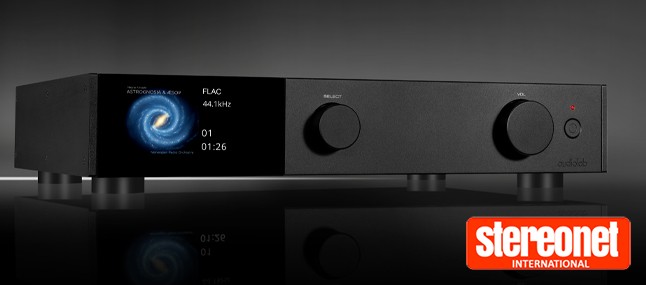
Two rotary controls ('select' and 'volume') and a single 'standby' button contribute to a clean, assured look with an unfussy fascia augmented by a 4.3-inch colour IPS LCD full-colour screen that can display album artwork. The screen is also the gateway to the 9000N's menu system, providing numerous options, including the digital upsampling and filter settings, fixed or variable analogue output, left/right channel balance, time idle before entering standby, volume curtailment upon powerup and Wi-Fi diagnostic data. You can even set the display to a VU-style meter showing real-time decibel levels for the left and right channels.
A Wi-Fi antenna and Ethernet port handle network connectivity, and USB-B and USB-A ports permit asynchronous PC/Mac connection and USB storage input, respectively. The 9000N can perform as a USB DAC as well as a network streamer.

Analogue outputs are provided in both single-ended RCA and balanced XLR form, with fixed and variable output options – the latter engages the 9000N's volume control, performing preamp duties for direct connection to a power amplifier. S/PDIF digital outputs in coaxial and optical flavours enable the streamer to be connected to an external DAC if desired.
The Audiolab 9000N network streamer is available in black or silver from mid-September and will sell for £2,499 inc. VAT.
For more information visit Audiolab

Posted in: Hi-Fi
Join the Discussion
What do you think? Head to the forums and share your thoughts with 100,000+ other community members.
Go to Forums