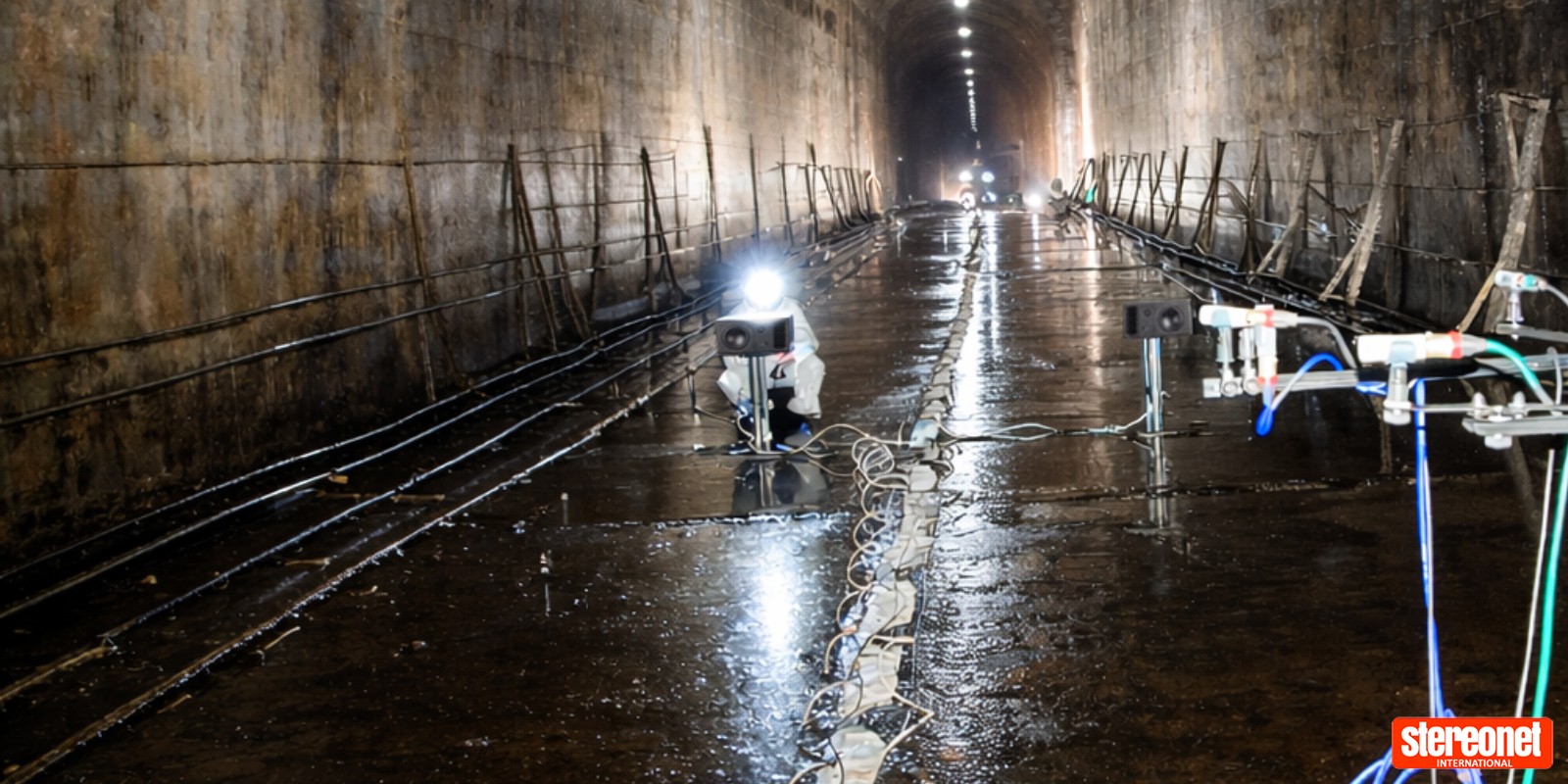
To begin his quest for record-breaking reverb, Grammy Award-winning producer Andrew Scheps (Adele, Red Hot Chilli Peppers, Metallica) headed to Inchindown oil tanks in the Scottish Highlands. He brought along some trusty PMC6 Studio Monitors to capture the unique acoustics.

Andrew Scheps in more comfortable surroundings
Located north of Inverness and concealed inside a hill on private land, the Inchindown oil tanks were commissioned by the Royal Navy in 1938 amid growing concerns about Germany's armed forces. The resulting six tanks, 237m long by 9m wide by 13m high, have a combined capacity of 32 million gallons.

Notably, this site set the 2012 Guinness World Record for reverb when Salford University acoustic engineer Professor Trevor Cox recorded a pistol shot echo lasting 112 seconds.
Andrew Scheps told StereoNET:
It doesn't matter how many photos you see; it’s impossible to get the scale and perspective of the place. The only access into the nearest tank is down a tube where the oil used to come in and out. You lie on what’s literally a giant pizza peel and get shoved down the tube with your arms above your head because it’s so narrow, and all your gear has to fit through as well.
Given the challenging environment, Scheps, a longtime PMC user, had to carefully select his equipment. He opted for a pair of PMC6s for playback, a 7.0.4 immersive microphone array, and a laptop for music playback.

The compact PMC6s were chosen not just for their size but also for their power and impact in the large space. Scheps explained, "There are moments in the music when most other speakers that would fit down the tube would struggle to reproduce big, loud, low-end tones. My Dolby Atmos room, Punkerpad UK, is entirely PMC, so the voicing of them makes sense to me – I didn't have to worry about what it was going to sound like."
The music included a track that Scheps produced, House in the Woods by Low Roar, a band signed to his label. “It's very atmospheric and sad, and I played it through the speakers and recorded the reverb on it,” he explains. “It's hard to describe how insane it is. We played other tracks that some producers and artists had sent me, and we also recorded impulse responses. These frequency sweeps go from 20Hz-20kHz, so you need speakers that can reproduce in that range at a decent volume and keep the frequency responses close to flat.”

It’s not all fun and games, though, with Scheps stating, “Once inside, everything about it is horrible: it’s about 8°C and pitch dark, and there’s 10cm of sludge underfoot – water mixed with oil that's seeped back out of the concrete. But that's what makes the reverb so amazing, because all the gaps in the concrete are filled in with oil; it's almost completely smooth.”
This stark environment is a far cry from Scheps’ immersive setup at home, where he uses PMC MB3 XBD-A main monitors and PMC wafer2s in a 9.1.4 configuration.
Scheps is now considering the Inchindown recordings as part of an ongoing project to visit other highly reverberant venues around the world, clearly relishing what was accomplished in Scotland.
For more information visit PMC
Gallery

Join the Discussion
What do you think? Head to the forums and share your thoughts with 100,000+ other community members.
Go to Forums