Back in 2021, Cambridge Audio released the Evo 150 streaming system, and StereoNET was instantly impressed. David Price noted, "It takes a minute or so of playing with the Evo 150 to realise how good it is ergonomically, but far less when you're talking about its sound. You only need to get through the first few bars of your favourite piece of music to realise that it's a top performer at the price." So, any update, replacement, or successor to this all-in-one system has its work cut out.
Fast-forward to 2025, and the company – now simply called Cambridge – has released the Evo 150 SE. While the new model has a couple of notable upgrades to the original's already winning formula, the biggest trend bucker must be the fact that the latest version costs less than the original Evo 150.

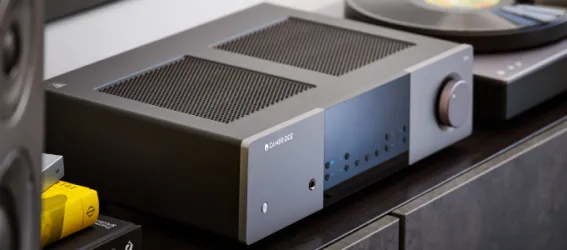
The new Evo 150 SE is a smart-looking device that doesn't scream for attention, but rather sits in quiet confidence. Measuring a compact, table-top-friendly 39x317x352mm [HxWxD], it sports a raft of digital and analogue inputs alongside wireless options. Indeed, it boasts a moving magnet phono stage at the end of a pair of stereo RCA inputs, line-level inputs in both RCA and balanced XLR flavours, digital coaxial, digital optical, Ethernet, USB-B and HDMI ARC.

Wireless alternatives offered include Bluetooth 4.2 with aptX HD codec compatibility and dual-band Wi-Fi. Moreover, once hooked up to your local network, the compact Cambridge can flex its Roon Ready, AirPlay 2, and Chromecast skills; it also supports 'Connect' versions of Spotify (including the new 'Lossless' service) and TIDAL - Qobuz Connect can be used via Chromecast, alongside Qobuz, internet radio, Amazon Music, Deezer and more within the app.
Digital content is handled by an ESS Sabre ES9018K2M DAC, an upgrade from the previous chip, which is capable of handling up to 32-bit/284kHz and DSD256.

Outputs include binding posts for two sets of speaker cables, a 3.5mm headphone socket and a preamp-out for a subwoofer; you'll also find pre-outs to connect up a power amp. Meanwhile, thanks to the 150 SE's ability as a Bluetooth transmitter as well as receiver, you can even connect it to your wireless headphones.
As per the original, the new SE version outputs a claimed 150 watts per channel into an 8 ohm load from its Class D amplifier. And here is where the SE markedly differentiates itself from its predecessor. The latest model is outfitted with a pair of 'Tuned by Cambridge' Hypex NCOREx Class D power modules. This is the result of some close collaboration between the two companies.

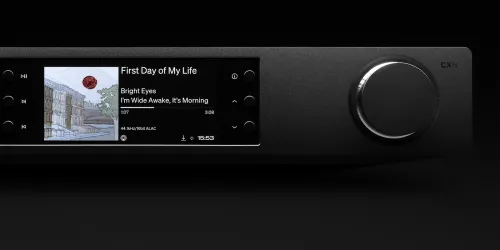
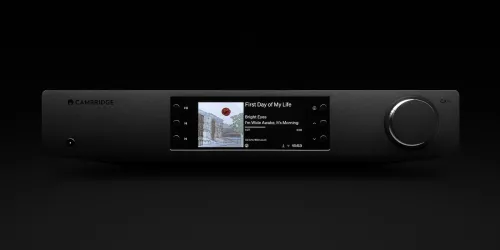
Another update is the dual-concentric dial on the fascia. In one elegant solution, it hands you volume control and input selection. The outer section is finished in a new knurled pattern. However, the Evo 150 SE is also supplied with a modern, minimalist remote control handset that makes up for in functionality what it lacks in tactile or visual excitement.

Alongside the refreshed dial sits a 6.8-inch full-colour display that shows menus, album artwork or – as is all the rage, right now – virtual VU meters. The chassis flanks are home to magnetically attached panels; Cambridge offers the choice of a grey slatted pair or a real wood veneer alternative in the box.

In addition to controlling the unit via the remote or on-screen menus, you have the better option of using the latest 4th-gen version of the StreamMagic control app. It is clean, logical, stable and offers plenty of functionality. Here you have access to EQ adjustment, room compensation – albeit basic – streaming service integration, internet radio access and much more from your mobile handset. The fact that you can specify only the inputs you are using to appear on the front page also cuts down on unwanted screen clutter.

Getting the Cambridge onto your local network is straightforward. Once started for the first time, you'll get the QR code screen that sends you to download the StreamMagic app. From the app, select the relevant model, and then locate the Wi-Fi network that the Cambridge creates. Connect to it, and then it sniffs out your home network. Select that, enter your password, and it's sorted. Granted, the Evo 150 SE isn't alone with this skillset, but it is fuss-free, stable, and those over thirty years old will be able to understand how to do it.

One thing worth noting is to opt for banana or bare wire terminations on your speaker cable rather than spade connectors. I had to select the B speaker terminals when attaching my Tellurium Q Black Plus cables between the Cambridge and my Marten Duke 2, thanks to the large, quality spade ends. I managed, but it rendered the pre-out and coaxial input practically useless. Such is the trade-off when offering a component the same width as an LP.
The Listening
This compact do-it-all streaming system retains everything that we were previously impressed with, and adds more. Its voicing is still on the warm side of neutral, as I found when tuning into my usual breakfast of Planet Rock while savouring my morning cappuccino. There were no jagged edges to rudely snap me from my semi-comatose state. In fact, Romeo from Chairlift's Moth proved as expansive and dynamic as I've heard from separates systems costing considerably more.

The Evo 150 SE is versatile enough to deliver both crashing transients and delicate subtleties, as outlined by Jacqueline du Pré's reading of Dvořák's Cello Concerto in B minor. However, it is this amp's ability to keep everything in focus that makes for an expressive and enjoyable performance of any given piece of music, classic or contemporary.

The compact Cambridge unfurls a large and well-defined soundstage, both front-back and left-right. For example, Blackest Eyes from Porcupine Tree could easily be unpicked through the Cambridge/Marten combo. Swapping these speakers for a pair of Focal's Aria 906, also helped tame the Evo's tendency to flesh out lower frequencies too much. This added an extra dash of drama and excitement.

This amp coped admirably with massive dynamic shifts, even while presenting the challenging harmonics of maestros like Frank Zappa and Captain Beefheart. The Robert Glasper Experiment's Black Radio was a case in point, and this track also highlighted the Evo 150 SE's ability with vocals, keeping a keen focus on the midrange. At the same time, dry snare sounds not only demonstrated the Cambridge's speed, but also its clear top end.

The phono stage is more than a box-ticking exercise, as there are parallels to be made with the company's Alva offerings. The Cure's Mixes of a Lost World sounded inviting, dark and mysterious with this unit's slightly warm, bass-oriented bias.

The StreamMagic EQ came in handy when using the Evo 150 SE's eARc connection on boxsets such as the latest season of Wednesday. Here, some of the whispered dialogue was enhanced by selecting the Voice Clarity preset, which boosts the midrange and treble while reducing the bass. However, that also lost the impact of the rumble we all now expect, so a manual curve did the trick. To be fair, the Naim Mu-so 2, which generally takes on soundbar-like duties, also needed tweaking in this respect, but I did prefer the sound through my Audiovector R 3 Arrete once it was dialled in.
The Verdict
 The new Cambridge Evo 150 SE is a great all-round one-box system that is hard to fault in so many areas. It has a large, spacious, confident sound with plenty of detail across a wide selection of programme material. Bass is a tad on the warm side, but this should flatter the type of loudspeakers – i.e. compact standmounters – that it's typically going to be used with. Factor in its plethora of inputs and raft of streaming options, and you have a highly competent compact.
For more information visit Cambridge
Gallery


Posted in: Amplifiers | Integrated Amplifier | Applause Awards | 2025 | Sources | Music Streamers | Hi-Fi
Join the Discussion
What do you think? Head to the forums and share your thoughts with 100,000+ other community members.
Go to Forums