

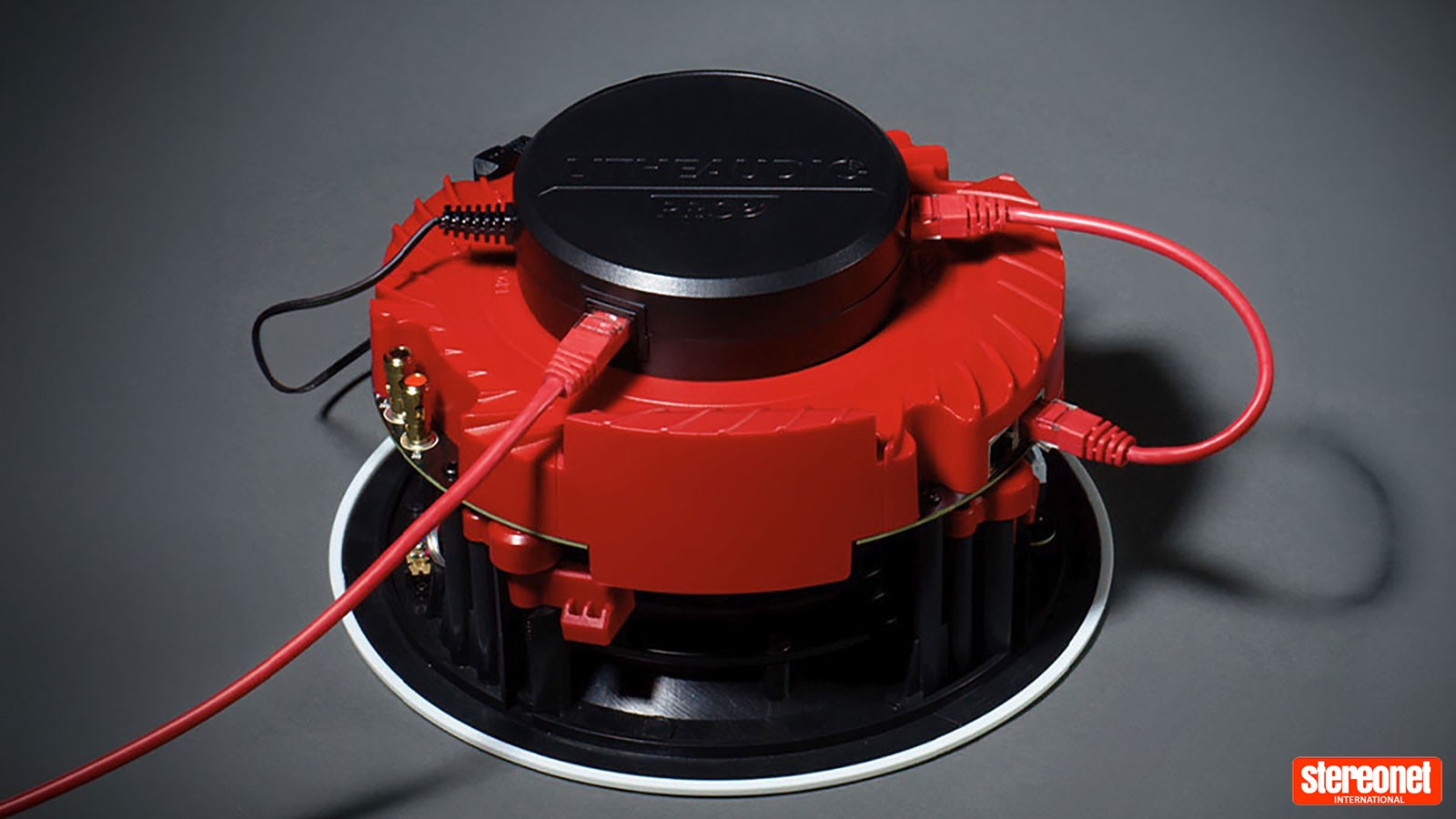
The new module is aimed at installers working across hospitality, retail, office, multi-dwelling and residential projects where running separate mains power and network cabling can add time, cost and complexity. Rather than requiring a local power outlet or mains feed at each speaker position, the Bolt-On allows compatible Lithe Audio PRO Series ceiling speakers to be powered via CAT cabling using the IEEE 802.3bt PoE++ standard.
The installer benefit is clear, with just one RJ45 connection able to handle both network connectivity and up to 60W of power for each speaker. Out on the job site, that equates to fewer cable runs, less need to get mains power to every speaker position, and a simpler route through those awkward jobs where ceiling access is never quite as generous as the plans suggested.

On the technical side, the module uses the IEEE 802.3af/at/bt PoE standard and is designed as a powered device for Lithe Audio’s PRO Series speakers. Lithe lists power handling at up to 71.3W, with installers needing a PoE++ injector or switch capable of supplying at least 60W, plus CAT5 or CAT6 cabling. Maximum cable distance is quoted at 100 metres, which should be enough for most residential, commercial and MDU deployments, provided the network infrastructure is properly specified.
As more commercial spaces, apartments and smart homes move towards IP-based infrastructure, audio systems are increasingly expected to behave less like isolated hi-fi products and more like networked building services. Lithe Audio’s approach sits neatly in that lane, particularly for projects where background music, paging or multiroom audio needs to be deployed quickly and reliably.

The Bolt-On module clips onto the rear of compatible PRO Series ceiling speakers and is designed specifically for that platform. Lithe Audio says the system removes the need for separate amplifiers, controllers or local speaker power supplies, with the PRO Series speaker handling amplification and networked playback within the speaker ecosystem itself.
The updated design also adds Ethernet network output alongside PoE++ input, allowing a single PoE++ cable to provide both speaker power and a live hard-wired network connection. That should make the module more useful in commercial spaces where Wi-Fi may be unreliable, congested or simply not preferred for critical installed audio.
For installers, the use case is not especially glamorous, but it is important. Restaurants, hotels, retail stores and boardrooms rarely need showpiece audio hardware in every ceiling bay. What they do need is consistency, clean deployment and the ability to service or scale a system without pulling apart half the building. A modular PoE++ adaptor makes sense in that context, especially where existing network infrastructure is already part of the fit-out.

The module’s commercial pitch is also helped by the fact that PoE is already familiar territory for security cameras, wireless access points and other building systems. Bringing ceiling speakers into that same cabling mindset may make Lithe Audio’s system easier for electricians, network installers and AV integrators to specify on mixed-infrastructure projects.
That said, this is not a universal upgrade for every ceiling speaker installation. The PoE++ Bolt-On is designed for Lithe Audio’s PRO Series speakers only, and installers will still need appropriate PoE++ switching or injector hardware capable of supplying the required power. In larger systems, power budgeting across the network will matter just as much as speaker placement.

The Lithe Audio PRO PoE Bolt-On is listed in Australia at A$399 each through Lithe Audio’s local distribution and dealer network.
For more information visit Lithe Audio
Gallery


Posted in: Integration | Industry
Join the Discussion
What do you think? Head to the forums and share your thoughts with 100,000+ other community members.
Go to Forums