
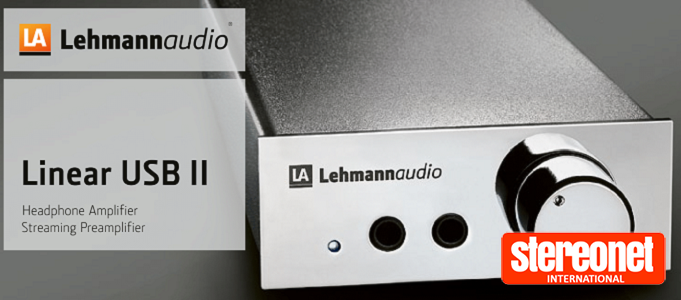
Lehmann's classic headphone amp design gets a complete audiophile overhaul. First coming on the scene in 2004, the Linear raised the standard for headphone amplifiers to a new level.

Today, 15 years after the original Linear made waves, the Linear II is now available in the UK in two different models; the Linear USB II, for playing high-resolution audio from a PC or Laptop, and the Linear D MK II, which upgrades DAC performance from alternative digital sources.
The Linear II features a discrete Class A output stage, high-grade Low-Z Copper technology across the PCB circuitry. Additionally, it gets specially selected components – such as the oversized internal power supply and low-loss MKP precision capacitors.
Linear USB II

The Linear USB II automatically detects any incoming USB audio data stream, without the need for an input selector switch. The technology employed utilises an ESS Sabre K2M DAC chip, capable of 32-bit / 384kHz playback and DSD support (DoP) for playback of very high-resolution digital audio files.
Linear D MK II
Linear D II guarantees the highest performance from your existing digital sources. With Optical (Toslink) and Coaxial (RCA 75Ohms) inputs, it automatically detects the playing audio (Optical input is prioritised) and converts the raw digital data using a sophisticated ESS Sabre K2M DAC chip.
According to Lehmann:
The new Linear models deliver physical, punchy lows and startling resolution in an open and natural soundstage over the entire frequency bandwidth, allowing your headphones to fulfil their highest potential.
Handily, each Linear II model features three Gain settings up-to 20dB and also benefits from two Neutrik headphone sockets with gold-plated contacts, which can be used simultaneously. This will make system matching a cinch.

The Left headphone output mutes the rear line-level RCA output when a headphone is connected. There is also an additional analogue RCA input for connecting to more traditional line-level sources.
Linear II models can also function very well as streaming pre-amplifiers for a full hi-fi system (when Gain is set to 0dB, and no headphone is connected). With their auto-input detection and sophisticated internal layout, they offer a simple-yet-high-end solution that can easily drive long cables toward a power amplifier or active speakers.
The Linear USB II and Linear D II are true reference-class headphone pre-amplifiers. Utilising a sturdy metal housing with SSC damping feet, for effective decoupling from environmental factors, the aluminium faceplate is available in Black, Silver or Chrome finishes. The latter comes with an additional premium.
Price and availability
- Linear USB II £1,700.00 (SRP)
- Linear D MK II £1,700.00 (SRP)
Both models are available to order in the UK now in Black or Silver finish. The chrome faceplate finish costs an extra £100.00 (SRP).
Tech Spec
- Input Impedance: 47kΩ
- Gain Settings: 0 dB, 10 dB, 18 dB, 20 dB
- selectable via DIP switches
- Frequency Response: 10Hz (-0.3dB) to 35kHz (-1dB)
- Signal to Noise Ratio: > 100dB at gain 0dB
- THD: < 0.001% at 6mW / 300Ω
- Channel Separation: > 80dB at 10kHz
- Output Power: 400mW / 60Ω
- 200mW / 300Ω
- Output Impedance: Line Out: 50Ω
- Headphone Out: 5Ω
- Audio Connectors: Neutrik headphone jacks with gold plated contacts
- (Left headphone output mutes line out)
- Gold plated RCA sockets with Teflon Insulation
- Power Consumption: 15W
- Special Feature: PCB made using Low-Z Copper Technology
- Vibration-absorbing SSC feet
- Outer Dimensions (W x D x H): 110 x 280 x 44mm
- Weight: 1.5kg net
Linear USB II
- Digital Inputs: 1 x USB Type-B
- DAC Technology: ESS Sabre 9018K2M
- Analogue Filter: Silver Mica capacitators
- Special Feature: Analogue input is activated when no digital signal is recognised
Linear D MK II
- Digital Inputs: 1 x Optical (Toslink)
- 1 x Coax (RCA)
- DAC Technology: ESS Sabre 9018K2M
- Analogue Filter: Silver Mica capacitators
- Special Feature: Analogue input is activated when no digital signal is recognised

Posted in: Headphones
Join the Discussion
What do you think? Head to the forums and share your thoughts with 100,000+ other community members.
Go to Forums