
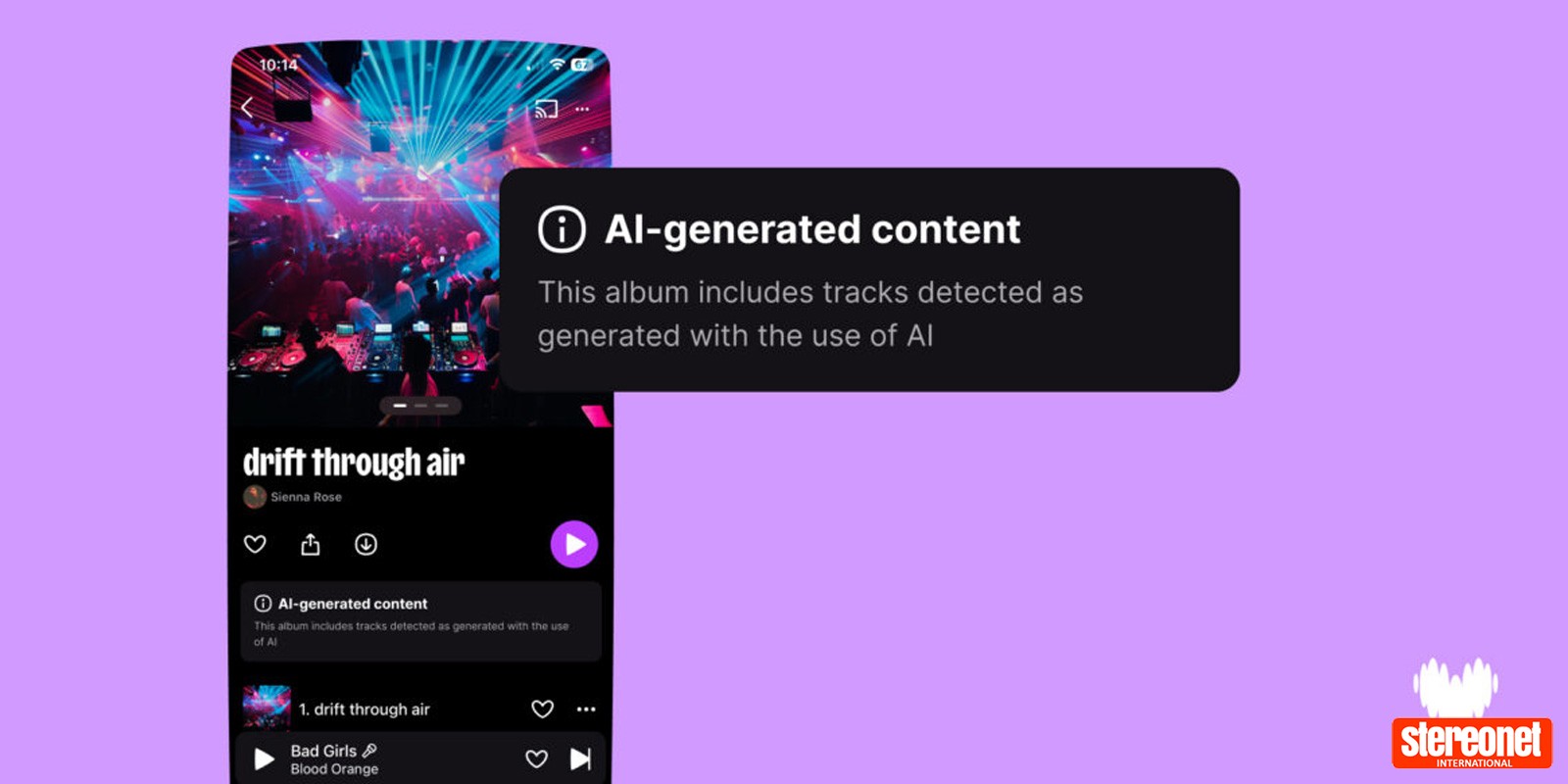

The French streaming service reports that around 75,000 fully AI-generated tracks are now being delivered to Deezer every day, representing roughly 44% of all new uploads. That figure has accelerated quickly. When the company first deployed its detection tools in early 2025, it was identifying around 10,000 AI tracks per day. By September, that had climbed to 30,000, reaching 50,000 by the end of the year.
StereoNET reported on the emerging AI issue at the time, when Deezer first raised concerns about the surge in synthetic content and its potential impact on streaming fraud and artist royalties. Twelve months on, the question isn’t whether it’s growing, but rather how far it’s already gone.

Despite the volume, Deezer says AI-generated material still accounts for only 1–3% of total streams. However, the company claims that up to 85% of those streams in 2025 were fraudulent, with associated plays removed from royalty calculations. That distinction matters not all AI music is problematic, but the scale of low-effort, mass-generated uploads appears to be.
In response, Deezer has expanded its in-house detection systems, which it says have now identified and tagged more than 13.4 million AI-generated tracks. Content flagged as synthetic is excluded from algorithmic recommendations and editorial playlists, and Deezer has also moved to limit storage of high-resolution versions, keeping playback available but deprioritised.

The company is now positioning its detection tools as a broader industry solution, arguing that platform-level tagging, transparency and fraud controls are no longer optional if streaming services want to protect the integrity of royalty pools.
Other platforms are moving, albeit more cautiously. Spotify has introduced rules targeting impersonation, undisclosed synthetic vocals and large-scale “noise” uploads, while requiring disclosure of certain AI-assisted production methods. However, it has yet to implement consistent listener-facing labelling for AI-generated tracks, something Deezer is pushing for.
Qobuz, by contrast, has drawn a firmer line. As StereoNET covered earlier this year, its AI Charter centres on a “human-first” approach, with detection running across new releases and the back catalogue, and AI content clearly labelled in-app. It also retains the option to remove or reject fully synthetic or fraudulent material, while keeping discovery largely in the hands of human editors.

In this writer's opinion, the problem isn’t AI music full stop, but rather how much of it is getting into the system, and where it lands. Enough low-effort AI material can start to shape what gets surfaced and what gets buried. If you’re using Deezer’s Flow, you may have already been hearing the shift, even if the broader catalogue still looks intact.
The royalty question for artists is another area of concern. If large volumes of artificially generated tracks are able to attract streams, whether legitimate or otherwise, that’s effectively siphoning value away from human artists.
The real shift over the past year is scale. That’s been the defining pattern of AI across multiple industries. Once the tools land, adoption accelerates quickly. Music is now seeing the same effect. AI-generated tracks haven’t just appeared; they’ve grown to represent a meaningful share of new uploads on a major platform.

Deezer’s numbers don’t so much signal a future risk as confirm an ever-present reality. What happens next isn’t inevitable, it’s a choice, and one that’s still very much up for grabs.
Join the discussion
Gallery

Posted in: Music
Join the Discussion
What do you think? Head to the forums and share your thoughts with 100,000+ other community members.
Go to Forums