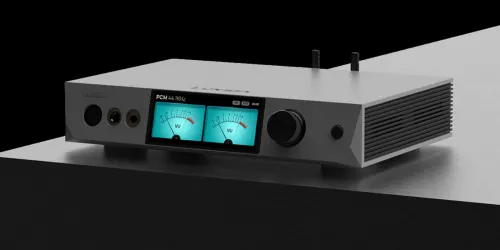
While the earlier model focused on reference-grade sound quality and stability, the new X8 expands that foundation with a far stronger emphasis on software, signal processing and user-adaptive tuning, including what Luxsin claims is the world’s first AI-assisted parametric EQ system.
According to the company, development of the X8 began before the X9 even reached market, which we reviewed last year, allowing early user feedback to inform both its hardware and software design. The result, Luxsin says, is a more refined platform designed to make high-quality headphone listening both more powerful and more accessible.

Key to the X8 capabilities is an eight-DAC parallel architecture built around Cirrus Logic’s CS43198 chips. Four DACs are assigned to each channel in a fully independent dual-mono layout, featuring separate power supplies, signal paths, and circuit boards for the left and right channels. Luxsin says this approach improves signal-to-noise ratio, dynamic range and low-level detail while maintaining stable stereo imaging and spatial accuracy.
Each DAC is individually shielded to reduce interference from digital circuitry and enhance thermal stability, while a high-speed buffering system ensures all eight converters are locked to the same clock domain for precise timing and consistency during high-resolution playback.

Driving the digital side is Luxsin’s Digital Audio Core, a custom processing platform built on a dual-core HiFi-5 DSP and ARM architecture running at over 500 MHz. Unlike conventional DAC DSP stages, this system has been designed with sufficient headroom for complex real-time processing and future firmware expansion, including edge-level AI audio functions.
That processing power enables the X8’s most distinctive feature: AI-assisted parametric EQ. Through Luxsin’s mobile app or web interface, users can adjust their sound using voice or text commands, either generating an overall tonal profile or fine-tuning specific elements of the response. Luxsin positions this as a way to make professional-grade EQ accessible to listeners who don’t want to manually build filter curves or rely on preset sound modes.

On the analogue side, the X8 uses a fully separated linear power supply, with digital and analogue circuits powered independently to minimise noise and interference. Users can select between 12-volt and 15-volt analogue rail operation, allowing the amplifier stage to be optimised for different headphones and listening conditions.

Output power is rated at 4.8 watts per channel, delivered via multiple OPA1612 op-amps and TPA6120A2 high-current drivers, with each channel driven independently. Luxsin says this provides sufficient current and voltage swing to control demanding flagship headphones while maintaining low distortion and high linearity.
An upgraded impedance detection system measures connected headphones across all outputs, including 4-pin XLR, 4.4 mm balanced and 6.35 mm single-ended and automatically selects the appropriate gain. The detection circuitry is isolated from the main signal path, ensuring it does not affect audio quality.

The X8 also stores independent settings for each output, including volume, EQ and effects, allowing users to switch between headphones without having to reconfigure the system each time.
Control is handled via a 4-inch full-colour touchscreen, alongside mobile apps for iOS and Android, a web-based interface for Windows and macOS, and an optional IR remote. Firmware updates can be applied locally or online, positioning the X8 as an evolving platform rather than a fixed-function DAC. Connectivity includes USB-B and USB-C, optical, coaxial and IIS digital inputs, plus 12-volt trigger ports for integration into larger systems.

With its combination of high-output analogue hardware and AI-driven tuning, the Luxsin X8 is aimed at listeners who want both reference-grade performance and modern, software-based control. The Luxsin X8 will retail for US$699 | €699.
For more information visit Luxsin
Gallery


Posted in: Hi-Fi | Headphones
Join the Discussion
What do you think? Head to the forums and share your thoughts with 100,000+ other community members.
Go to Forums